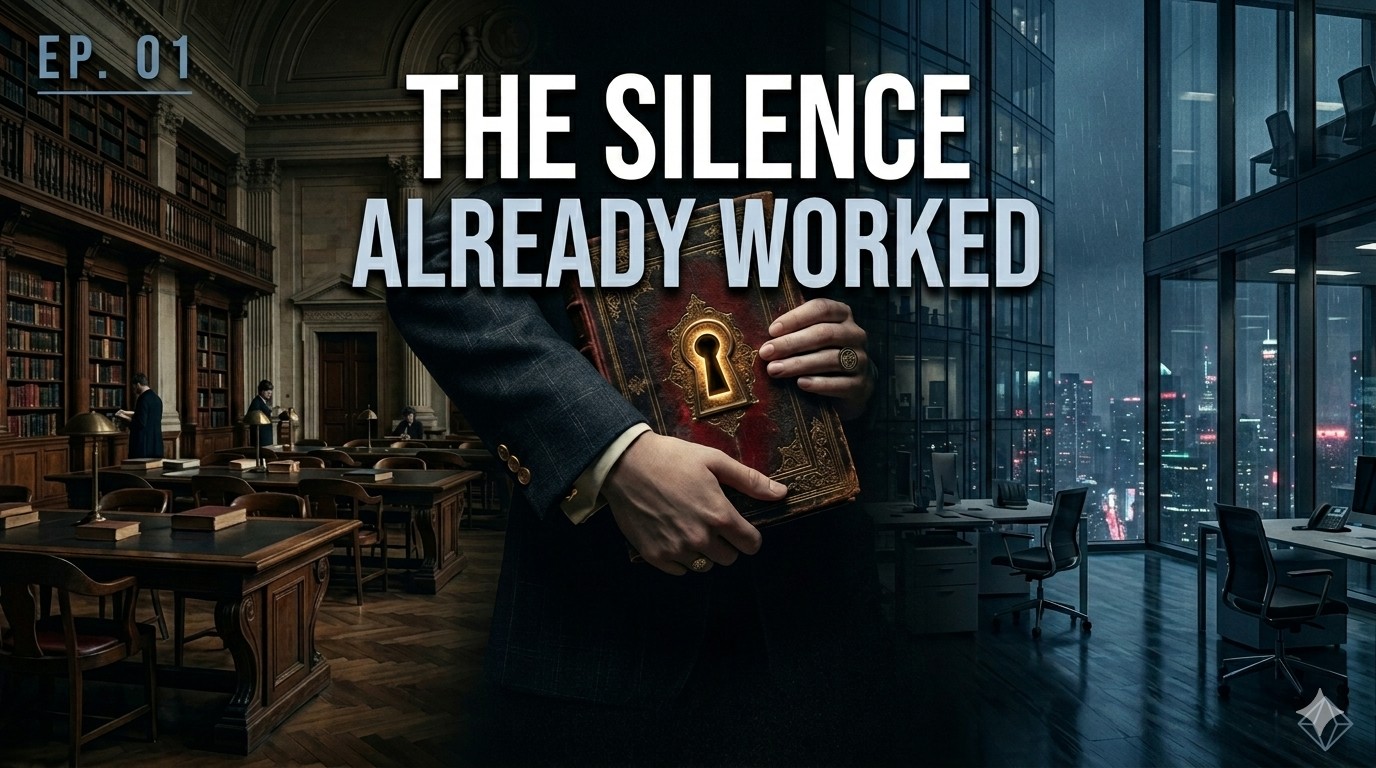
You walked out of the room with a clear understanding. A decision had been made, a direction confirmed, maybe even a specific commitment given. And then, days later, that certainty was quietly removed — replaced by someone else's version of events delivered as fact. The disorientation that follows is not a gap in your memory. It is a response to something that actually happened.
What makes this experience difficult to name is that it mimics ordinary miscommunication. People do mishear. Meetings do produce ambiguity. The professional environment already trains us to defer to authority, to assume we may have missed something, and to keep friction to a minimum. Doubt becomes the path of least resistance.
PATTERN OVERVIEW
Some dynamics in professional environments systematically erode an individual's confidence in their own perception over time. They do not operate through open conflict or obvious aggression. Instead, they function through repetition — a slow accumulation of small moments in which a person's account is treated as incorrect, exaggerated, or emotionally compromised. The setting amplifies the effect: hierarchy provides cover, professional norms discourage confrontation, and the cost of being labeled difficult is high enough to keep most people silent. The result is an environment that feels stable on the surface while quietly destabilizing the people working inside it.
THE FOUR SIGNALS
Signal 1. You raise a concern in a one-on-one, and the response is not a counter-argument or a clarification — it is a comment on your reaction. You are told that you are reading too much into something, or that your feelings about it are out of proportion. The substance of what you said is never addressed. The conversation has moved on before you realized it happened.
Signal 2. A colleague references a meeting outcome you both attended. The outcome they describe is different from what you recorded in your own notes. When you say so, the response is immediate: everyone else left with the same understanding. You find yourself wondering, privately, whether to check your notes again — not because you think they are wrong, but because the alternative is confronting something you do not yet have words for.
Signal 3. You follow up in writing after a significant conversation — not to challenge anything, simply to confirm what was agreed. The reply comes back with a reframe so subtle that you almost miss it: a timeline shifted, a commitment softened, a qualifier added that was not there before. Nothing is denied outright. There is no obvious moment to point to. But the record no longer matches what you experienced.
Signal 4. You bring a documented discrepancy forward — something concrete, something you can show. The response does not engage with the evidence. Instead, you are told that you are making this bigger than it needs to be, that this kind of thing can damage working relationships, that others have not found it necessary to keep track like this. The documentation is treated not as clarification but as an act of aggression.
WHY IT GOES UNNOTICED
Professional environments create a specific kind of cognitive vulnerability: they reward deference and penalize friction. When doubt is introduced by someone with positional authority, the mind weighs the cost of trusting itself against the cost of being wrong in public. Most of the time, self-doubt is the safer calculation. This is not irrationality — it is the logical output of a social system that has trained people to treat seniority as a form of accuracy. The pattern exploits exactly that training.
WHAT FOLLOWS
If any of these moments felt familiar, that recognition is worth taking seriously. The annotated script for this episode — including research context, cut material, and sources — is available for Patreon subscribers. The documentation protocol discussed in the episode is also available there as a downloadable reference.